For this year’s World Day Against Trafficking in Persons, we shine a light on the people and partnerships responding to scam-related trafficking and exploitation.
A fake job advertisement can travel faster and further than any trafficker ever could.
With a few clicks, criminal networks can recruit across borders and generate billions of dollars through sophisticated online scams. For Rinrawin Srisiripong, a Public Prosecutor with Thailand’s Department of Trafficking in Persons Litigation, those digital crumbs can be used to help answer an essential question: Is the person behind the scam actually a victim of trafficking?
Across Southeast Asia, online scam operations have evolved into a sprawling criminal industry. The United Nations Office on Drugs and Crime estimates that scams generated between USD 88.3 billion and USD 114.1 billion in losses across East and Southeast Asia, Australia and New Zealand in 2025, while people from at least 80 countries and territories have been identified in scam compounds throughout the ASEAN region.
Yet behind those staggering figures are stories that rarely make headlines.
What first attracted Rinrawin to a career in prosecution was the ability to ensure that justice is not driven solely by accusation or defence, but by a careful examination of the facts.
That conviction deepened when she had the opportunity to join the Office of the Attorney General’s specialised trafficking division. Unlike many criminal offences, trafficking cases demand an understanding not only of the law, but also of human rights, victim protection and the realities of exploitation.
It is precisely that complexity that keeps her in the field.
One of the first trafficking cases Prosecutor Rinrawin handled involved a girl who had been exploited in a karaoke venue. By the time the case reached trial, she had turned 18 and was no longer eligible for special child witness protections. During witness preparation, she asked whether she felt ready to face the defendants in court.
The answer revealed a truth that still stays with her.
The young woman was afraid – not only because of the trauma she had endured, but because she had developed an emotional bond with the very people who had exploited her. The relationship between trafficker and victim was far more complicated than many would imagine.
Recognising her vulnerability, Rinrawin successfully requested that she testify remotely via live video link while receiving support from NGO staff.
“There is no single approach that fits every case,” she reflects. “It always depends on the individual circumstances.”
Justice, she realised, is not simply about securing convictions. It is also about ensuring survivors can participate in the legal process without suffering further harm.
Years later, another trafficking case would leave an even deeper impression.
A Thai woman accepted what appeared to be a legitimate job opportunity in a neighbouring country. Instead, she was trafficked into a scam compound, where she endured physical violence, sexual exploitation and degrading living conditions for more than a year.
During her captivity, she became pregnant. Eventually, she managed to seek help from the Thai authorities and was screened as a victim of trafficking.
Today, she is raising her child and rebuilding her life. Prosecutor Rinrawin knows, “The physical wounds may heal, but the emotional scars can last a lifetime.”
Her story mirrors a wider regional crisis. The United Nations has documented extensive abuse within scam compounds, including physical and sexual violence, threats of intimidation and punishment, confinement and isolation.
Many victims are recruited through advertisements for customer service, marketing or technology jobs. Once inside scam operations, passports may be confiscated, movement restricted and unrealistic targets imposed. Some are forced to process financial transactions or participate in online fraud. Over time, many are conditioned to believe they are criminals themselves.
That belief often prevents them from speaking out and seeking help.
As a country with long and porous border, Thailand faces these challenges alongside its neighbours. Recruitment may occur in one country, exploitation in another, while money, digital evidence and criminal networks span several more. No nation can tackle the problem alone.
For Prosecutor Rinrawin, stronger regional cooperation offers one of the clearest paths forward. Information sharing, parallel investigations and trusted professional networks help authorities respond to crimes that move as easily as a message sent across a smartphone screen.
But prevention remains just as important as prosecution.
Criminal groups are constantly adapting, using social media and highly professionalised – advertisements to target people seeking employment opportunities. Public awareness, digital literacy and better resources for exposing false or deceptive jobs can interrupt that cycle before exploitation begins.
Her advice is simple.
Pause before accepting an offer that seems too good to be true.
Verify the employer.
Ask questions.
Most importantly, seek help if something feels wrong.
While prevention is undeniably the best response, evidence suggests that the region is yet to make a significant impact on scamming and the trafficking that sustains it.
For Prosecutor Rinrawin, this necessitates stronger regional cooperation.
As trafficking networks operate across borders, ASEAN countries must do the same – working together to identify and protect victims, share digital evidence, trace illicit financial flows and disrupt criminal networks.
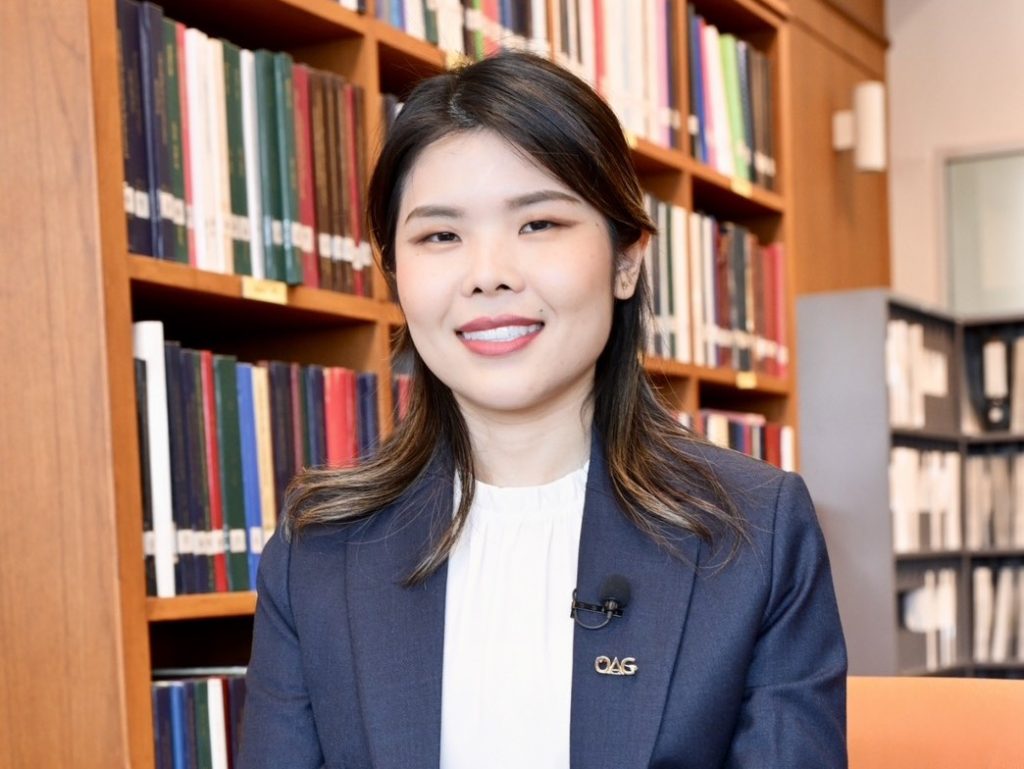
Photo: Rinrawin Srisiripong, a Public Prosecutor with Thailand’s Department of Trafficking in Persons Litigation, Office of the Attorney General.
The Office of the Attorney General (OAG) is the lead government agency responsible for prosecuting criminal cases in Thailand. Within the OAG, the Department of Trafficking in Persons Litigation (DTIPL) is responsible for prosecuting trafficking in persons (TIP) cases nationwide, pursuing victim compensation claims, and providing legal expertise and support on other legal aspects related to counter-trafficking in persons in Thailand.
OAG is a key partner of ASEAN-ACT working on a number initiatives including the Modern Slavery Conference, International Legal Cooperation, knowledge exchange for judges and prosecutors and the development of a standard of operation on multi-disciplinary team’s meeting on victim compensation.
OAG, in partnership with UNODC, is currently working to enhance transnational prosecutions by empowering public prosecutors to lead law enforcement agencies in building cases and establishing guidelines for transnational matters through international intelligence networks, with a focus on dismantling high-level criminal networks.