For this year’s World Day Against Trafficking in Persons, we shine a light on the people and partnerships responding to scam-related trafficking and exploitation.
More than 2.1 million Filipinos work overseas, leaving home each year in search of opportunities, financial security, and a chance to build better futures for the people they love. For many Filipinos, migration is a story of sacrifice, ambition, and hard-earned social and economic mobility.
But for many individuals seeking a better future, that same hope becomes the entry point for exploitation.
Attorney Kristina Escosia has spent years working with Filipinos whose migration journeys did not work out as planned. As Chief of the AIRTIP Programs Monitoring, Coordination and Technical Support Services Division of the Migrant Workers Protection Bureau at the Philippines’ Department of Migrant Workers (DMW), she works at the intersection of prevention, protection, and justice, helping ensure Filipinos migrate safely and successfully, while ensuring that those who experience exploitation are not left to navigate the aftermath alone.
After a career in corporate and tax law, Atty Kristina found her way into labour migration and public service.
“It is very challenging work,” she says. “But it is deeply meaningful. Every successful intervention can change a person’s life.”
One lesson has remained constant throughout her career: trafficking in persons often begins with the establishment of trust between a trafficker and their victim.
In the context of trafficking into online scamming, recruitment often starts with a message on social media. An online job advertisement. A recruiter who sounds professional. A salary that could transform lives.
The offer may be for a customer service role or a marketing position. The recruitment process can appear legitimate. Interviews are conducted online. Documents look authentic. For many victims, nothing initially seems suspicious.
“The jobs they were promised do not exist,” Atty Kristina explains.
Instead, victims often find themselves trapped inside heavily guarded scam compounds where passports are confiscated, communication is restricted, and their movements controlled. Some are forced to participate in online fraud schemes involving cryptocurrency scams, identity theft, and romance scams. Many endure threats, intimidation, and physical abuse.
What troubles Atty Kristina most is how often the public misunderstands these experiences.
“The biggest misconception is that they are willing participants,” she says.
But trafficking operates through a complex web of deception, coercion, and control, often exploiting a victim’s position of vulnerability.
In the scamming compounds, some workers fear for their own safety. Others fear harm or consequences for their families. Some survivors describe being pressured to recruit other Filipinos into the compounds – a stark illustration of how traffickers create impossible choices for people whose freedom and safety are already being used against them.
The stereotype of who becomes trafficked is equally misleading.
“We have interviewed professionals, managers, supervisors, call-centre agents, and university graduates,” Atty Kristina says. “Education levels does not guard against becoming a victim.”
The scale of the problem is becoming increasingly visible.
In March 2025, the Philippine Government repatriated 206 Filipinos believed to be trafficking victims from scam compounds in Myanmar after they had been recruited through online platforms and false job offers. By August 2025, Philippine authorities reported that 629 alleged Filipino trafficking victims had been repatriated from scam hubs in Myanmar, Cambodia, and Laos since the beginning of the year.
Some return carrying debt. Others struggle with anxiety, shame, or a loss of confidence. Many worry about how they will explain their experiences to future employers, friends, or even family members. Some hesitate to seek assistance because they fear being judged for what happened to them and what they were forced to do.
Recovery, Atty Kristina believes, cannot be measured by a safe return alone.
To support survivors, the DMW follows a victim-centred, trauma-informed, and gender-responsive approach – recognising that every person’s experience of trafficking is different and that recovery cannot be rushed. Through legal assistance, counselling, financial support, and livelihood opportunities, the Department helps survivors rebuild their confidence, independence, and sense of possibility.
“We want them to know they are not defined by what happened to them,” she says. “They have rights. They have opportunities. And they have a future beyond this experience.”
What continues to inspire her are the survivors themselves.
She recalls groups of Filipinos who endured months of uncertainty, threats, and isolation inside scam compounds. Many did not know when – or if – they would see their families again. Some have courageously chosen to share their experiences with government agencies to improve policies such as the multi-sectoral victim-sensitive guidelines in the justice system, spearheaded by the Supreme Court to the Philippines and launched in 2024.
Their stories challenge a common narrative about trafficking. Too often survivors are viewed through the lens of victimhood alone.
Atty Kristina sees something different. She sees people who survived exploitation and still found the strength to help others avoid the same fate.
And she sees a reminder that behind every trafficking case is not a statistic, but a person who was saving for their children’s education. Someone supporting ageing parents. Someone trying to build a future.
Her advice to aspirant migrants: “Verify before you fly.”
But beyond vigilance, she hopes the public will offer something equally important: empathy. The people trapped behind these scams should not be defined by the crimes they were forced to commit.
Because behind every scam is a stolen opportunity, a broken promise, and a person still fighting to reclaim their future.
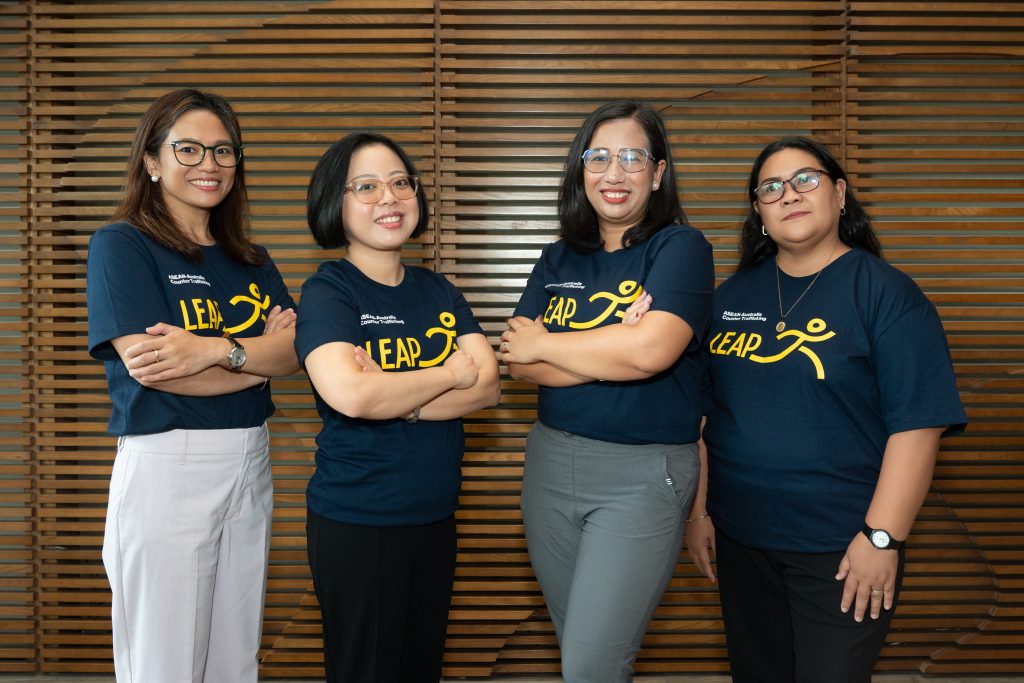
Attorney Kristina Escosia is a participant in the second cohort of the Counter Trafficking in Persons Leadership Excellence in ASEAN Program (CTIP LEAP), delivered by the Australian Government funded ASEAN-Australia Counter Trafficking (ASEAN-ACT) program.