In public sector reform, we often know what needs to change and how to initiate it. Often the more challenging part of reforming a system is making it stick and sustaining change over time.
Government systems to counter trafficking in persons are no exception. Across Southeast Asia, governments supported by development partners have invested significantly in counter trafficking capacity, yet trafficking remains one of the region’s most complex and persistent threats and the number of cases identified represents a fraction of the known cases.
The issue is not a shortage of technical solutions. The challenge is often creating the conditions that allow those policy initiatives to be implemented, sustained and scaled.
Policies do not implement themselves. Coordination mechanisms do not automatically create collaboration. Real progress depends on leaders who can navigate complexity, influence across institutional boundaries, build trust across agencies and create the conditions for collective action and mutual accountability.
Recognising this gap, the Australian Government-funded ASEAN-Australia Counter Trafficking program (ASEAN-ACT) developed the Counter Trafficking in Persons Leadership Excellence in ASEAN Program (LEAP).
Unlike the more technically focused aspects of the program, LEAP was intentionally designed to strengthen the leadership capabilities of public sector officials with key roles in counter trafficking.
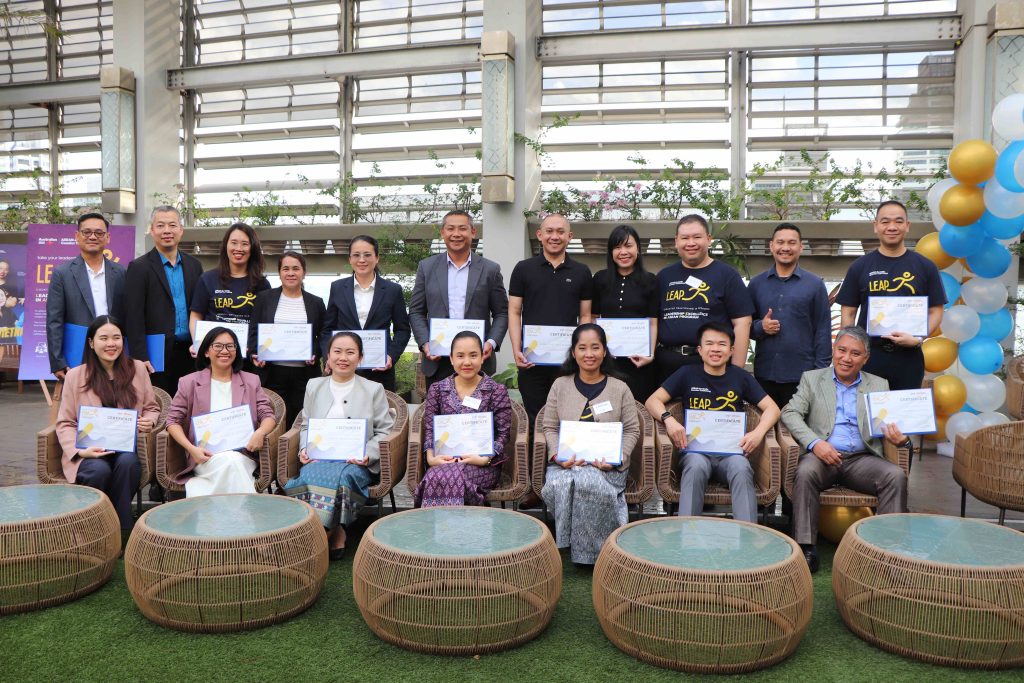
With the inaugural cohort successfully graduating in December 2025, ASEAN-ACT saw an opportunity to look beyond participant satisfaction surveys and ask a bigger question: did our investment in leadership development shift systems?
An independent review assessed LEAP against five key evaluation questions. The results showed LEAP was highly relevant and delivering impact at individual, organisational and system levels. Some of the findings, however, challenged conventional assumptions about what makes leadership development effective, and where its greatest value lies.
From learning leadership to leading change
Leadership programs are often judged by what participants learn. Arguably, a more meaningful measure is what they do differently afterwards.
The pilot CTIP LEAP program, launched in January 2025, brought together 20 mid to senior-level government officials from Cambodia, Lao PDR, the Philippines, Thailand and Viet Nam. Participants held frontline and leadership roles across the counter-trafficking responses, representing law enforcement, judiciary, labour and migration, social welfare and shelter services, financial investigations and national coordinating bodies.
Over 12 months, participants engaged in virtual and in-person workshops, coaching, self-assessment tools and ‘Capstone Projects’ focused on real institutional challenges in each of the four participating countries.
The review found strong evidence that participants applied their learning directly within their agencies. Participants reported adopting new leadership approaches, strengthening cross-agency collaboration, contributing more effectively to National Action Plans and improving engagement with their teams and stakeholders. Supervisors of the LEAP leaders observed greater confidence, more inclusive leadership and stronger effectiveness in national and regional forums.
A key factor in the program’s success was its practical application through the Capstone Projects. For example, in the Philippines, leaders harmonised curriculum for national counter-trafficking agencies. And in Cambodia, a new leadership module was embedded into existing frontliner training. The projects highlighted an important insight: leadership is not something that happens alongside systems change, it is often the mechanism through which systems change occurs.
The reality of delivery
Like leadership itself, the program was not delivered in a perfect environment.
Several struggled to carve out space for learning alongside demanding professional responsibilities. Others wondered whether they still had anything new to learn after years of experience in senior roles. These learnings demonstrated that leadership development is as much about reflection and mindset as it is about acquiring new skills.
Virtual learning was often overshadowed by the competing demands of participants’ day-to-day roles, while in-person workshops offered the protected time needed for reflection, connection and meaningful learning.
The review also highlighted the realities of delivering a regional program across diverse cultural and linguistic contexts. Bringing together participants from different countries and disciplines was one of the program’s greatest strengths, but it also required facilitators to adapt learning approaches to ensure meaningful participation across varying levels of English proficiency and different cultural perspectives.
Coaching presented another lesson. As a relatively unfamiliar approach in Southeast Asia, fewer than half of the available sessions were taken up by the participants. However, those who participated reported significant benefits, with one participant subsequently introducing coaching within their own management team.
These findings reinforce an important lesson often overlooked in leadership development: transformation is rarely driven by content alone. Time to reflect, trust, organisational support, cultural familiarity and psychological safety all help create the conditions for learning to be applied in practice.
The hidden returns that matter most
The review found that many participants described a shift in mindset. Rather than feeling responsible for having all the answers, they became more comfortable drawing on the knowledge and perspectives of others.
These changes matter because they create the foundations for sustained reform. In environments characterised by competing priorities, complex hierarchies and limited resources, technical expertise alone is rarely enough. Progress depends on leaders who can build trust, foster collaboration and mobilise collective action.
The most powerful outcome of leadership development may not be a new policy or initiative. It may be a leader who approaches challenges differently, and in doing so influences how an entire institution adapts and responds.
Looking ahead
The LEAP review provided encouraging evidence that leadership development can be both highly relevant and highly impactful when it is grounded in real work, tailored to context and focused on systems change.
For donors and development partners, the message is clear: leadership development is not a soft investment operating at the margins of reform. It is a strategic investment in how reform happens.
Technical expertise tells us what needs to change. Leadership is what helps change move.
And in complex systems such as counter-trafficking, where progress depends on countless decisions, relationships and acts of collaboration, that movement can be the difference between isolated interventions and lasting impact.
The independent review was conducted by Ethos of Engagement between January to March 2026. Download a summary of the Independent Review.
The second cohort of the CTIP Leadership Excellence in ASEAN Program (LEAP) commenced in July 2026 with the first module held in Ho Chi Minh City Vietnam (August 2026), bringing together a new group of government leaders from across the region, including participants from Indonesia for the first time.
Polaris Consultancy will continue the delivery of the second cohort.
Hear from the participants of the first cohort:
To find out more, visit www.aseanact.org/leadership